Legal Guide · 12 min read · March 6, 2026
What Is Revenge Porn? Definition, Laws & How to Remove It
Revenge porn is the non-consensual sharing of intimate images. Learn what it is, where it's illegal, and how to find and remove content — step by step.
Revenge porn is the non-consensual sharing of intimate or sexually explicit images — typically by a former partner — with the intent to humiliate, intimidate, or harm the person depicted. Also known as non-consensual intimate imagery (NCII) or image-based sexual abuse, revenge porn is illegal in most U.S. states, across the European Union, and in a growing number of countries worldwide.
If someone has shared your intimate photos without your consent — or is threatening to — this guide explains what revenge porn is, where it’s illegal, and exactly how to find and remove it.
In this guide:
- Common Forms of Revenge Porn
- How Revenge Porn Harms Victims
- Legal Status of Revenge Porn
- What to Do If You’re a Victim
- How to Prevent Revenge Porn
- How Privacy Leak Can Help
- FAQ
- Key Takeaways
Common Forms of Revenge Porn
Revenge porn isn’t limited to one scenario. It takes several distinct forms, and understanding them matters because each affects the legal options available to victims.
Direct upload by an ex-partner. The most recognized form. After a breakup, a former partner uploads intimate photos or videos to adult websites, social media, or sends them directly to the victim’s family, friends, or employer. The intent is almost always to punish, humiliate, or coerce the victim into resuming the relationship.
Threatened distribution. Sometimes the images are never actually posted — instead, the perpetrator threatens to share them as a form of emotional control or blackmail. This overlaps with sextortion and is a separate criminal offense in many jurisdictions, even if the images are never released.
Mass sharing on dedicated “leak” sites. Some websites exist specifically to host non-consensual intimate images, often organized by the victim’s name, location, or social media profile. These sites are particularly harmful because they pair the explicit content with identifying information.
Deepfake revenge porn. Increasingly, perpetrators use AI tools to generate explicit content that never existed. By placing the victim’s face onto pornographic material, they create convincing fake images that are just as damaging as real ones. Deepfake intimate content is treated as revenge porn under many newer laws, including the U.S. Take It Down Act.
Secondary sharing. The original upload is only the beginning. Once intimate images are online, they get scraped, re-uploaded, and shared across multiple platforms — sometimes by people who have no connection to the original perpetrator. Victims often find their images on dozens of sites they’ve never heard of.
How Revenge Porn Harms Victims
The damage caused by revenge porn extends far beyond embarrassment. It is a form of abuse with documented psychological, social, and professional consequences.
According to the Cyber Civil Rights Initiative, 93% of revenge porn victims report significant emotional distress, and 51% report suicidal ideation. Many experience anxiety, depression, and PTSD that persist long after the content is removed.
The social impact can be devastating. Victims frequently describe damaged relationships with family and friends who discovered the content. In cases where identifying information accompanies the images, victims have been harassed, stalked, and even physically threatened by strangers online.
Professionally, the consequences are severe. Employers who discover the content — or who receive it directly from the perpetrator — may terminate the victim. Job searches become fraught with fear that a background check or casual Google search will surface the images. For public-facing professionals, the career damage can be permanent.
The psychological toll is compounded by the difficulty of removal. Knowing that your intimate images are circulating online — and not knowing exactly where — creates a persistent state of anxiety and loss of control that many victims describe as the worst part of the experience.
Legal Status of Revenge Porn
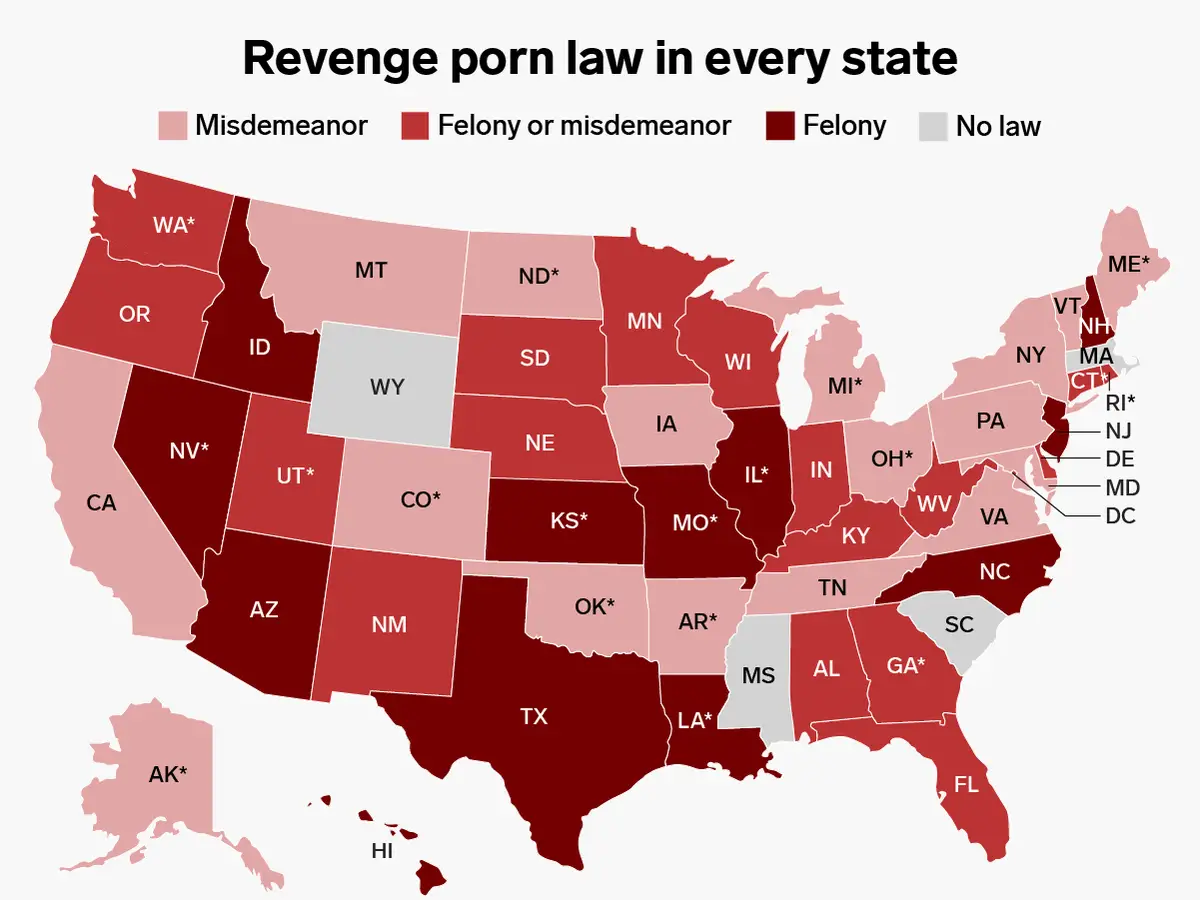
Revenge porn laws have expanded dramatically over the past decade. Here’s where things stand in major jurisdictions.
United States
There is no single federal law that criminalizes revenge porn broadly, but the legal landscape is strong and getting stronger.
The Take It Down Act — signed into law in May 2025 — requires online platforms to remove non-consensual intimate images (including AI-generated deepfakes) within 48 hours of receiving a valid removal request. This is the most significant federal action to date.
At the state level, 48 states plus Washington D.C. now have laws criminalizing the non-consensual distribution of intimate images. Penalties vary widely — from misdemeanors with fines to felony charges carrying prison sentences, depending on the state and circumstances. Civil remedies (allowing victims to sue for damages) are available in many states as well.
The DMCA (Digital Millennium Copyright Act) provides an additional path: if you took the photo yourself, you hold the copyright and can issue takedown notices to platforms and hosting providers.
European Union
The EU’s General Data Protection Regulation (GDPR) gives individuals the “right to erasure” — the right to demand that organizations delete personal data, including intimate images. Several EU member states have also enacted specific criminal laws against revenge porn, with penalties including fines and imprisonment.
Other jurisdictions
The UK’s Online Safety Act addresses revenge porn with criminal penalties. Australia, Canada, Japan, South Korea, and the Philippines all have laws specifically targeting non-consensual image sharing. The legal trend globally is toward stronger protections and harsher penalties.
For detailed guidance on filing legal removal requests, see our DMCA Takedown Guide.
What to Do If You’re a Victim
If you’ve discovered revenge porn of yourself — or if someone is threatening to share your intimate images — follow these steps.
1. Document everything immediately
Before you do anything else, screenshot every instance you can find: the content itself, the URL, the page title, any usernames or comments, and the date. If the perpetrator sent threats via text or messaging, screenshot those too. Save everything in a secure, password-protected folder. This evidence is essential for legal action, platform reports, and takedown requests.
2. Do not contact the perpetrator
This is difficult but important. Confronting the person who shared your images often backfires — they may delete evidence, escalate their behavior, or upload more content in retaliation. Let the legal process and platform reporting work on your behalf.
3. Report to the platform
Every major platform has a process for removing non-consensual intimate content. For adult sites, look for their content removal or DMCA reporting form. For social media platforms (Facebook, Instagram, TikTok, Twitter/X), use the built-in reporting system and select the option related to intimate images shared without consent.
4. Use StopNCII.org to prevent re-uploads
StopNCII.org — run by the UK Revenge Porn Helpline — creates a digital hash of your images that participating platforms use to automatically block re-uploads. This is free and doesn’t require you to send your actual images to anyone.
5. File for legal removal
You have two primary legal paths in the U.S.:
DMCA takedown notice — if you took the photo/video yourself (you own the copyright). Note that DMCA filings require your real name and contact information.
Take It Down Act request — for any non-consensual intimate image, regardless of who holds the copyright. This applies even to deepfakes.
6. Scan for copies you don’t know about
The vast majority of revenge porn doesn’t stay on one site. Use facial recognition tools to search across adult platforms for additional copies you may not have found through manual searching. The earlier you discover copies, the faster you can get them removed before they spread further.
7. Report to law enforcement
If the distribution of your images is criminal in your jurisdiction (it is in most U.S. states), file a police report. Also consider reporting to the FBI’s IC3 if the offense involves interstate or international elements, which most online offenses do.
How to Prevent Revenge Porn
Complete prevention isn’t always possible, but these steps significantly reduce your risk.
Be cautious about sharing intimate images. If you choose to share intimate photos, be aware that any digital image can be screenshotted, saved, or forwarded. There is no technology that guarantees a photo will disappear after viewing, regardless of what messaging apps claim.
Audit your cloud storage. Ensure your iCloud, Google Photos, Dropbox, and other cloud accounts use strong, unique passwords and two-factor authentication. Many leaks originate from compromised cloud accounts, not from direct sharing.
Monitor proactively. Regular scanning — whether through free tools like Google Alerts or facial recognition services — lets you catch unauthorized sharing early, before content has time to spread widely. Early detection dramatically simplifies the removal process.
Know your legal rights. Understanding that revenge porn is illegal in your jurisdiction — and knowing the reporting and removal steps in advance — means you can act immediately if it happens to you or someone you know.
How Privacy Leak Can Help
Privacy Leak addresses the two hardest parts of the revenge porn crisis: finding where your images appear and removing them without exposing your identity.
Discovery. Privacy Leak’s facial recognition scans your face across hundreds of millions of indexed images on adult platforms, deepfake galleries, and image hosting sites. Unlike Google or TinEye, it matches your facial features — not a specific image file — so it catches cropped, filtered, and manipulated photos. It also offers voice search, tattoo search, and AI deepfake detection for content where your face may be obscured.
Removal. Privacy Leak’s Legal Takedown Service files DMCA and Take It Down Act notices on your behalf. Your identity is never shared with platforms or uploaders. Most content is removed within 24–72 hours. Non-compliant platforms are escalated through hosting providers, domain registrars, and CDN services.
Monitoring. Premium and Enterprise plans include real-time monitoring that alerts you immediately when new matches are detected — critical for catching re-uploads before they spread.
→ Try a free scan at privacyleak.ai
FAQ
What is revenge porn in simple terms?
Revenge porn is when someone shares your intimate or sexual photos without your permission, usually to hurt or humiliate you. It most often happens after a breakup, but it can also involve hackers, scammers, or AI-generated deepfakes. It is illegal in most U.S. states and many countries worldwide.
Is revenge porn illegal?
Yes, in most places. In the U.S., 48 states plus D.C. have specific revenge porn laws, and the federal Take It Down Act requires platforms to remove non-consensual intimate images promptly. The EU’s GDPR provides data erasure rights, and many other countries have enacted similar legislation.
How can I check if I’m a victim of revenge porn?
Search your name and usernames on Google alongside terms like “leaked” or “nude” as a first step. Then use a facial recognition tool to scan adult content platforms — this catches images that Google and standard reverse image search tools miss. Privacy Leak offers a free tier with 5 facial recognition searches per day.
What should I do first if I discover revenge porn of myself?
Document everything immediately — screenshot every instance with the full URL, page title, and date. Do not contact the perpetrator, as this may cause them to destroy evidence or escalate. Then report to the hosting platform and file for legal removal through DMCA or the Take It Down Act.
Can revenge porn be permanently removed?
From individual platforms, yes — legal takedown requests are effective. However, once images have been widely shared, they may appear on multiple sites and require repeated removal requests. Ongoing monitoring is critical to catch re-uploads. The sooner you act, the fewer sites you’ll need to pursue.
What is the difference between revenge porn and sextortion?
Revenge porn is the actual sharing of intimate images without consent, typically for humiliation. Sextortion is the threat to share intimate images unless the victim pays money, provides more content, or complies with other demands. Both are illegal, and sextortion is classified as a form of extortion or blackmail in most jurisdictions.
How does Privacy Leak help with revenge porn removal?
Privacy Leak combines facial recognition search (to find where your images appear across adult sites) with a Legal Takedown Service (to get content removed). The takedown service files DMCA and Take It Down Act notices as your legal proxy, keeping your identity completely hidden from platforms and uploaders. Most content is removed within 24–72 hours.
Does revenge porn include deepfake content?
Yes. Many jurisdictions — including under the U.S. Take It Down Act — now treat AI-generated intimate content using someone’s likeness the same as real intimate images shared without consent. Deepfake revenge porn is both illegal and removable through the same legal channels as traditional revenge porn.
Key Takeaways
- Revenge porn is the non-consensual sharing of intimate images, and it’s illegal in 48 U.S. states, across the EU, and in many countries worldwide.
- Common forms include direct uploads by ex-partners, threatened distribution, mass sharing on leak sites, and AI-generated deepfakes.
- The Take It Down Act (signed May 2025) requires platforms to remove non-consensual intimate images promptly — including deepfakes.
- If you’re a victim: document everything, report to the platform, use StopNCII.org to block re-uploads, and file for legal removal through DMCA or the Take It Down Act.
- Filing DMCA yourself exposes your identity. Legal proxy services keep your information hidden throughout the removal process.
- The vast majority of revenge porn ends up on obscure platforms — facial recognition tools find what manual searching cannot.
You are not alone, and you are not powerless. If your intimate images were shared without your consent, the law is on your side — and the tools exist to take them down.
→ Start your free scan at privacyleak.ai
Related Articles
- Leaked Intimate Photos: How to Find Them and Get Them Removed pillar page covering the full discovery-to-removal process