Privacy · 15 min read · March 6, 2026
Leaked Intimate Photos: How to Find & Remove Them
Discover how to find leaked intimate photos of yourself online and get them removed fast. Free DIY methods, legal options, and facial recognition tools explained.
Leaked intimate photos are private sexual or nude images shared on the internet without the subject’s consent — and finding them is the first step toward getting them removed. Whether your images were uploaded by an ex-partner, stolen from a hacked account, or generated as AI deepfakes, this guide walks you through every method for discovering where your photos appear online and every legal path for taking them down.
If you’re reading this because you suspect — or already know — that your private photos are out there, understand two things. First, this is not your fault. Second, you have real options, both free and paid, to find that content and force its removal.
In this guide:
- Why Leaked Intimate Photos Are So Hard to Find
- What You Need Before Starting
- Step-by-Step: How to Find Leaked Photos of Yourself
- How to Remove Leaked Intimate Photos
- Discovery and Removal Tools Compared
- Common Problems and How to Solve Them
- FAQ
- Key Takeaways
Why Leaked Intimate Photos Are So Hard to Find
The biggest obstacle to removing leaked intimate photos is discovering they exist in the first place.
Most people assume that if their photos were leaked, they’d eventually find out. In reality, the vast majority of leaked content ends up on obscure, non-mainstream platforms — small adult forums, offshore image hosting sites, anonymous file-sharing boards, and Telegram channels that Google doesn’t index. Victims often go months or years without knowing their images are circulating.
The numbers reflect a growing crisis. According to the Cyber Civil Rights Initiative, roughly 1 in 12 U.S. adults has been a victim of non-consensual intimate image (NCII) distribution. And the problem is accelerating: the Home Security Heroes 2023 deepfake report found that deepfake pornography videos online increased by 550% between 2019 and 2023, with 98% of all deepfakes being pornographic.
This isn’t limited to any single scenario. Leaked photos come from many sources:
Revenge porn. An ex-partner uploads intimate images to punish, humiliate, or control the victim. This is the most commonly recognized form and is illegal in most U.S. states and many countries.
Hacked accounts. Cloud storage, messaging apps, and email accounts get compromised. Attackers steal private photos and upload them to adult sites or sell them in bulk on dark web forums.
Deepfake generation. AI tools place a real person’s face onto explicit content that never actually existed. Victims don’t need to have taken any intimate photos — their public social media selfies are enough for the AI to work with.
Content piracy. Paid content from platforms like OnlyFans gets downloaded by subscribers and re-uploaded to free sites without the creator’s permission.
Sextortion. Scammers trick victims into sharing intimate images during video calls or messaging, then threaten to publish them unless the victim pays.
No matter how the leak happened, the discovery-to-removal process follows the same general path.
What You Need Before Starting
Before you start searching, prepare the following. Having these ready will save time and reduce stress:
A clear, recent photo of your face. This is for facial recognition scanning. A well-lit, front-facing selfie with no sunglasses or heavy filters works best. It doesn’t need to be an intimate photo — the tool matches your facial features, not the image itself.
Your known usernames and real name. Write down every username, stage name, handle, and variation of your real name that could be associated with you online. These are useful for manual text-based searches.
A secure folder for evidence. Create a private folder (password-protected if possible) where you’ll save screenshots, URLs, dates, and any other evidence you find. If you need to escalate to legal action later, this documentation will be essential.
Emotional preparation. This is genuinely difficult. Searching for your own leaked images can be distressing, even if you find nothing. Consider asking a trusted friend to help, or take breaks during the process. If at any point you feel overwhelmed, the Cyber Civil Rights Initiative helpline (844-878-CCRI) offers free support for victims of non-consensual image sharing.
Step-by-Step: How to Find Leaked Photos of Yourself
Start with free methods, then move to more comprehensive tools if needed.
Step 1: Search Google and social media manually
Open Google and search for your real name, usernames, and any identifying details combined with terms like “leaked,” “nude,” “photos,” or the names of adult sites. Also search your usernames on Reddit (especially NSFW subreddits), Twitter/X, and Telegram public channels.
This method is limited — Google doesn’t index most adult sites — but it occasionally catches leaked images that appear on mainstream platforms.
Step 2: Use reverse image search tools
Upload your photos to free reverse image search tools:
Google Reverse Image Search — finds visually similar images across Google-indexed sites. Won’t cover adult platforms, but can catch leaks on social media or news sites.
TinEye — finds exact or near-exact copies of a specific image file. Useful if you suspect one particular photo has been re-uploaded somewhere. TinEye also shows the earliest known version of an image, which helps identify the original source.
Both tools share the same fundamental limitation: they match image files, not faces. If someone cropped, filtered, or screenshotted your photo, or if a completely different photo of you was posted, these tools will miss it entirely.
Step 3: Set up passive monitoring
Create a Google Alert for your name, usernames, and any identifying terms. You’ll get an email whenever Google indexes a new page containing those terms. This won’t catch most adult sites, but it runs continuously in the background at no cost.
If you’re an OnlyFans or content creator, also monitor known piracy forums and Telegram channels where leaked content tends to surface first. Some creators join private monitoring groups where members alert each other to new leaks.
Step 4: Use facial recognition to scan adult content
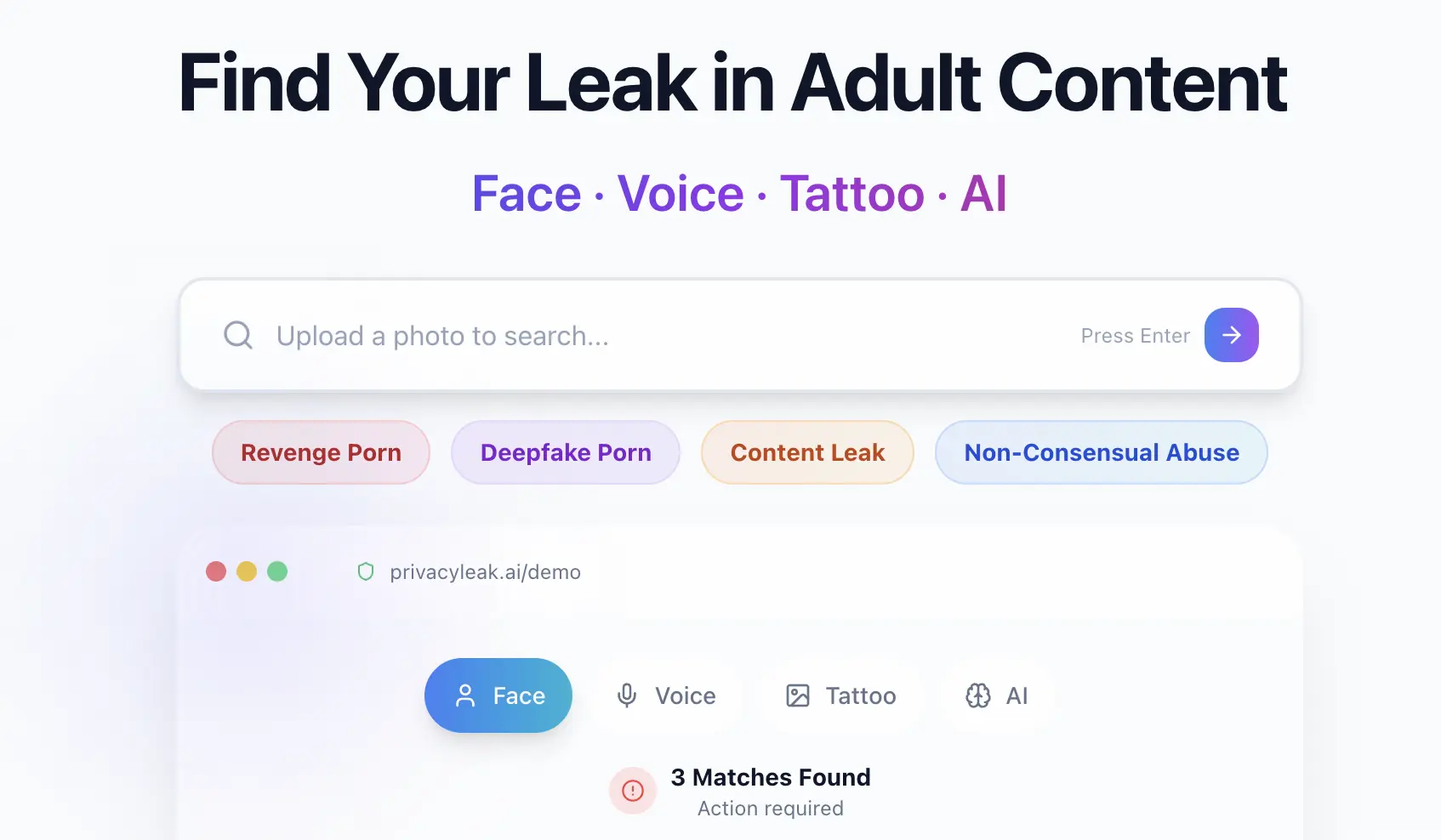
Free tools catch only a fraction of leaks. For a comprehensive search, facial recognition technology scans your face — not just one image file — across adult content databases.
Here’s how this works: you upload a clear photo of your face. The AI creates a mathematical representation of your facial features (a “faceprint”) and compares it against hundreds of millions of indexed images from adult platforms, deepfake galleries, image hosting sites, and forums. Results include the source website, URL, and a confidence score for each match.
Privacy Leak performs this scan in approximately 30 seconds. Beyond face matching, it also offers voice search (for leaked videos containing your voice), tattoo search (for content where your face is obscured but a distinctive tattoo is visible), and AI detection mode (for identifying deepfake content). If no matches are found, you can enable monitoring alerts to be notified if your face appears in the future.
→ Try a free scan at privacyleak.ai
Step 5: Document everything you find
For every match, save a screenshot of the page, the full URL, the website name, the date you found it, and any description or title text visible on the page. If using a facial recognition tool, also save the similarity score. Store all of this in your secure evidence folder.
This documentation is not optional. It’s required for DMCA takedown notices, Take It Down Act requests, platform reports, and any potential legal proceedings.
How to Remove Leaked Intimate Photos
Once you’ve found where your images appear, you have several removal paths — each with trade-offs.
Option 1: Report directly to the hosting platform
Most major adult platforms have processes for removing non-consensual content. Pornhub, XVideos, and xHamster all have dedicated reporting forms. In the U.S., the Take It Down Act — signed into law in May 2025 — requires platforms to remove non-consensual intimate images promptly after receiving a valid request.
For mainstream social media (Facebook, Instagram, TikTok, Reddit), use each platform’s built-in reporting system. Response times vary but are typically faster than adult sites.
Option 2: Use StopNCII.org for hash-based blocking
StopNCII.org — operated by the UK Revenge Porn Helpline — lets you create a digital “hash” (fingerprint) of your intimate images. Participating platforms (including Meta, TikTok, Reddit, Bumble, and others) automatically detect and block re-uploads matching that hash. This doesn’t remove content that already exists, but it prevents the same images from being re-uploaded to participating sites.
Option 3: File a DMCA takedown notice yourself
If the leaked content is a photo or video you took (meaning you own the copyright), you can file a DMCA takedown notice directly with the hosting platform, their hosting provider, or the domain registrar. This is a formal legal demand under U.S. copyright law.
Important caveat: DMCA notices require your real legal name and contact information, and this is shared with the platform and often forwarded to the uploader. For victims of revenge porn or sextortion, this identity exposure can be dangerous.
Option 4: Use a legal takedown service for anonymous removal
If protecting your identity during the removal process is a priority, Privacy Leak’s Legal Takedown Service handles it on your behalf. Their legal team files through the appropriate channel — DMCA or Take It Down Act — and sends formal notices to platforms and hosting providers. Your name and contact information are never shared. Most content is removed within 24–72 hours. If a platform doesn’t comply, they escalate through server providers, domain registrars, CDN services, and if necessary, regulatory bodies.
Option 5: Remove from search engine results
Even after source sites remove your content, cached versions may still appear in Google results. Use Google’s content removal request tool to request de-indexing. Processing typically takes 1–3 business days.
Option 6: Set up ongoing monitoring
Leaked images tend to resurface. After initial removal, set up real-time monitoring alerts to catch re-uploads early. The sooner you catch a re-upload, the fewer sites you’ll need to pursue.
Discovery and Removal Tools Compared
| Feature | Google + TinEye | PimEyes | FaceCheck | Privacy Leak |
|---|---|---|---|---|
| Facial recognition search | ❌ | ✅ | ✅ | ✅ |
| Scans adult content sites | ❌ | ✅ Good | ✅ Good | ✅ Deep coverage |
| Voice search | ❌ | ❌ | ❌ | ✅ |
| Tattoo search | ❌ | ❌ | ❌ | ✅ |
| AI deepfake detection | ❌ | Partial | Partial | ✅ |
| Built-in legal takedown | ❌ | ❌ (separate PROtect plan) | ❌ | ✅ DMCA + Take It Down Act |
| Identity protection during removal | ❌ | ❌ | ❌ | ✅ Acts as legal proxy |
| Real-time monitoring | ❌ | ✅ Paid add-on | ❌ | ✅ Premium & Enterprise |
| Free tier | ✅ | ❌ Paid only | Limited | ✅ 5 searches/day |
Google and TinEye are free and worth trying first, but they only match image files — not faces — and don’t search adult platforms. PimEyes offers strong facial recognition but focuses on discovery, not removal. FaceCheck provides adult content scanning but has no removal workflow. Privacy Leak is the only platform that combines face, voice, tattoo, and AI search with an integrated legal takedown service that keeps your identity hidden throughout the removal process.
Common Problems and How to Solve Them
“I filed a DMCA but the site ignored it.” Not all platforms comply voluntarily. If a site ignores your DMCA notice, escalate to their hosting provider (use a WHOIS lookup to find it), then their domain registrar, then their CDN provider. Each layer of infrastructure has its own abuse reporting process. A legal takedown service can handle this escalation chain for you.
“The content was removed but it appeared on another site.” This is common. Leaked images get scraped, re-uploaded, and shared across multiple platforms. The only reliable defense is ongoing monitoring with alerts that notify you when new matches appear. Early detection limits how far the content can spread.
“I didn’t take the photo — someone else took it, or it’s a deepfake.” If you didn’t take the photo, you may not hold the copyright, which complicates DMCA claims. However, the Take It Down Act (for non-consensual intimate imagery) doesn’t require copyright ownership — it applies to anyone whose intimate images were shared without consent. Deepfake content is also covered under many state laws and violates the terms of service of all major platforms.
“I found my content but I’m terrified of the uploader finding out I reported it.” This is the most common fear, and it’s valid. DIY DMCA filings expose your identity. Using a legal proxy service — where a legal team acts as your representative — keeps your name completely out of the process.
“I can’t afford paid tools.” Start with the free methods outlined above — Google reverse image search, TinEye, Google Alerts, and manual searching. Privacy Leak offers a free tier with 5 facial recognition searches per day. StopNCII.org is completely free for hash-based blocking. If you find content, many platform reporting forms and the Take It Down Act don’t cost anything to use.
FAQ
How do I find out if my intimate photos were leaked?
Start with free methods: search your name and usernames on Google alongside terms like “leaked” or “nude,” then try Google Reverse Image Search and TinEye with your photos. For a more comprehensive scan, use a facial recognition tool that searches across adult content platforms — these catch leaks that manual searching and file-matching tools miss.
Can I remove leaked intimate photos from the internet?
Yes. You can report directly to hosting platforms, file DMCA takedown notices, or submit requests under the Take It Down Act (U.S. law requiring platforms to remove non-consensual intimate images). For anonymous removal that protects your identity, Privacy Leak’s Legal Takedown Service handles the process on your behalf.
Is sharing someone’s intimate photos without consent illegal?
Yes, in most jurisdictions. In the U.S., the Take It Down Act makes it a federal matter, and most states have their own revenge porn laws. The EU’s GDPR provides data erasure rights. Many other countries have enacted similar legislation. Victims have strong legal grounds for demanding removal.
How long does it take to get leaked photos removed?
It depends on the platform. Major sites like Pornhub typically respond within a few days. Smaller or offshore sites may take longer or ignore requests entirely. Professional legal takedown services like Privacy Leak typically achieve removal within 24–72 hours and can escalate against non-compliant platforms.
Do I need a lawyer to remove leaked photos?
Not necessarily. You can file DMCA notices and platform reports yourself at no cost. However, DIY DMCA filings require sharing your real name and contact information. If you want to keep your identity protected — or if platforms aren’t responding — a legal takedown service handles the process as your legal proxy without requiring you to hire a personal attorney.
What if my leaked photos are deepfakes?
Deepfake intimate content — where AI places your face onto explicit material — is illegal in many U.S. states and violates platform terms of service. You can report deepfakes through the same channels as real leaked photos: platform reporting forms, DMCA notices (if you own the source face photo), and Take It Down Act requests. Privacy Leak’s AI detection mode specifically identifies deepfake content during facial recognition scans.
What is the Take It Down Act?
The Take It Down Act is a U.S. federal law signed in May 2025 that requires online platforms to remove non-consensual intimate images — including AI-generated deepfakes — promptly after receiving a valid removal request. It strengthens victims’ ability to demand removal regardless of who holds the copyright.
Can Privacy Leak find leaked photos that Google can’t?
Yes. Google doesn’t index most adult content sites and doesn’t use facial recognition. Privacy Leak scans hundreds of millions of indexed images across adult platforms using facial recognition, meaning it can find your face in photos that Google would never surface — including on obscure, overseas-hosted sites where the vast majority of leaked content ends up.
Key Takeaways
- The hardest part of dealing with leaked intimate photos is discovering they exist — most end up on obscure platforms that Google doesn’t index.
- Start free: manual Google searches, reverse image search (Google + TinEye), Google Alerts, and StopNCII.org hash blocking cost nothing.
- For comprehensive discovery, facial recognition tools scan your face (not just one image file) across adult content databases, catching leaks that free tools miss.
- You have multiple legal removal paths: direct platform reports, DMCA takedown notices, the Take It Down Act, and professional legal takedown services.
- Filing DMCA yourself exposes your identity. Legal proxy services keep your name hidden from platforms and uploaders.
- Set up monitoring after removal — leaked images frequently resurface on different sites.
Your photos belong to you. If they’ve been shared without your consent, you have both the legal right and the tools to take them down.
→ Start your free scan at privacyleak.ai
Related Articles
- [What Is Revenge Porn? Definition, Laws & How to Remove It] — glossary guide to revenge porn with legal overview
- [DMCA Takedown Request: Step-by-Step Guide to Remove Your Photos] — complete walkthrough for filing DMCA notices